
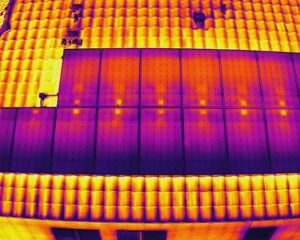
If you have solar panels on your property—residential, commercial, or industrial—there’s a window every June that most Arizona property owners overlook until it’s too late: the gap between dry spring and the first monsoon.
The first storm cell of the year can deposit dust, debris, and humidity across your array in a matter of hours. If your panels already had a developing hotspot, a cracked cell, or a failing connection before the storm, that weather event can push a minor issue into a real problem. Getting a Tucson solar panel drone inspection right now—before the monsoons kick in—is one of the most practical maintenance steps you can take this summer.
There’s also a solid operational reason the timing works in your favor. Temperatures are warm enough to put panels under full load and generate good thermal contrast, but the brutal midday heat of late July and August hasn’t fully arrived yet. That matters more than most people realize, and we’ll get into the details below.
What Does a Solar Panel Drone Inspection Include?
This is probably the most common question property owners ask before their first inspection, and it’s a fair one—there’s a big range in what different providers actually deliver.
A thorough drone solar inspection services Arizona operation covers much more than flying overhead and snapping photos. Here’s what a complete inspection looks like:
Thermal Imaging
The drone captures radiometric infrared data across your entire array. This reveals hotspots, failing cells, dead strings, and inverter-level issues that are completely invisible to the naked eye—and that your energy output monitoring won’t catch at the panel level.
Our thermal camera drone services use calibrated sensors that read temperature differences with enough precision to flag individual cell failures within a string.
RGB Visual Imaging
High-resolution visible-light photos document physical damage, soiling, shading obstructions, and installation anomalies alongside the thermal data.
The side-by-side pairing is what makes reports actually usable—you get context for every thermal finding.
Orthomosaic Mapping
For larger commercial and utility-scale arrays, the drone generates a geo-referenced map of your entire system.
Each identified defect is plotted with GPS coordinates so your maintenance team can find the exact panel without any guesswork. This is part of what makes our Tucson solar inspection drone services useful for multi-building commercial properties and ground-mounted systems.
When Is the Best Time to Schedule an Aerial Thermal Solar Panel Inspection in Tucson?
June is genuinely a strong month for this, and here’s why that’s not just a sales pitch.
Thermal drone inspections work by detecting temperature differences between healthy panels and those with defects. For that contrast to show up clearly in the data, two things need to be true:
- Your panels need to be under load (sunlight hitting them)
- The ambient air temperature needs to be cool enough relative to panel operating temperature to create a readable differential
In the peak of summer—late July through August in Tucson—ambient temperatures can push 105°F or higher.
When everything is baking, the difference between a healthy panel and a degraded one can be subtler in the thermal data. Early morning flights help, but the window is narrow.
In June, there’s a sweet spot:
- Strong, consistent solar production
- Cooler morning temperatures
- Excellent thermal contrast
- Spring dust and pollen accumulation at seasonal highs
This means any efficiency loss caused by dirt, debris, or developing defects becomes much easier to identify.
The other practical reason to schedule before monsoon season is simple: if you find a problem now, you have time to repair it before the storms arrive.
Moisture intrusion into a cracked panel or damaged junction box can quickly turn a straightforward repair into a costly replacement once monsoon rains begin.
How Often Should You Get a Solar Drone Inspection in Arizona?
For most Arizona solar systems, the right baseline is once per year at minimum.
For commercial properties and older systems, twice a year is increasingly becoming the standard.
New Systems (Under 2 Years Old)
Annual inspections are typically enough to catch early installation issues while equipment is still under warranty.
A thermal report documenting a manufacturing defect before the warranty period ends can be worth far more than the inspection cost.
Systems 2–10 Years Old
Annual drone inspections help you stay ahead of normal degradation.
Individual cell failures and developing hotspots are significantly less expensive to repair when discovered early.
Systems Over 10 Years Old
Semi-annual inspections are often worth considering.
Older panels and aging electrical connections are more likely to develop issues, and thermal documentation provides a valuable historical baseline for monitoring long-term performance.
After Major Weather Events
A post-monsoon inspection in October or November is a smart addition for Southern Arizona property owners.
High winds, hail, and airborne debris can cause damage that may not immediately appear in energy production reports.
The fast turnaround on drone inspections makes this maintenance schedule easy to follow. There is no need to shut down your system or send technicians onto the roof.
Across our Arizona service area, residential and small commercial arrays can typically be inspected in a single visit, with reports delivered within two business days.
What Happens If You Skip the Inspection?
Several aspects of solar panel degradation surprise property owners when they first learn about them.
Hotspots Get Worse, Not Better
A hotspot that begins as a small thermal anomaly can eventually become a serious fire hazard.
The affected cells create additional electrical and thermal stress on surrounding cells, accelerating degradation across the string.
Early detection almost always means lower repair costs.
Does Your Drone Pilot Need FAA Certification to Inspect Solar Panels in Arizona?
Yes—and this is something every property owner should verify before hiring a drone service provider.
Any commercial drone operation in Arizona requires the pilot to hold an FAA Part 107 Remote Pilot Certificate.
Solar panel inspections are clearly considered commercial drone operations, meaning providers flying without Part 107 certification are operating outside FAA regulations.
That can create liability concerns for both the pilot and the property owner.
Beyond basic Part 107 certification, pilots operating near airports or in controlled airspace may also require LAANC authorization or FAA waivers.
In Arizona, this is especially relevant due to airspace surrounding:
- Tucson International Airport
- Davis-Monthan Air Force Base
- Phoenix Sky Harbor Airport
- Multiple regional airports throughout the state
Desert Drones holds FAA Part 107 certification, LAANC approvals, and FAA waivers.
We also carry $2,000,000 in liability coverage.
When someone is flying over your property and inspecting expensive solar infrastructure, proper certification and insurance coverage matter.
Ready to Schedule Your Pre-Monsoon Inspection?
June is an ideal time to document your solar system and identify any issues before monsoon season arrives.
Whether you’re managing a commercial array in Tucson, a rooftop system in the Phoenix metro area, or a multi-site installation elsewhere in Arizona, our team can get you scheduled and deliver your report within 24–48 hours.
Desert Drones is a two-time Arizona Daily Star Readers’ Choice winner for Best Aerial Photographer (2023 and 2024), with more than five years of solar inspection experience across Tucson, Phoenix, and Southern Arizona.
Browse our solar inspection drone services to learn more about what’s included, or contact our team for a customized quote.
Contact Desert Drones LLC
Phone: (520) 214-8133
Website: desertdronesllc.com
Instagram: https://www.instagram.com/desertdronesllc?utm_source=ig_web_button_share_sheet&igsh=ZDNlZDc0MzIxNw==
Email: JOHN@DESERTDRONESLLC.COM