
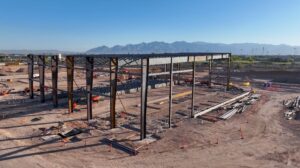
If you run jobs in Tucson or the Phoenix metro, you already know the feeling — the slab pour looks great on Tuesday, framing crews come and go on Wednesday, and by Friday the GC is asking for photos of something that’s already buried under drywall. Tucson construction drone photography solves that problem. A great schedule of flights keeps the whole job easier to manage.
This guide is for builders, project managers, owners, and architects who are trying to figure out what Tucson construction drone photography actually looks like in practice — what gets captured, how often flights make sense, what it costs, and how to plan around the Arizona seasons that quietly wreck other people’s schedules.
We’ve been documenting Arizona construction sites for over five years out of our Tucson HQ, and we serve the full Phoenix metro and the rest of the state too. Here’s the working playbook.
What Tucson Construction Drone Photography Actually Captures
The phrase “drone photos” undersells what a good construction flight delivers. A single mission can produce wide-context site overviews, milestone hero shots, oblique angles for marketing, top-down orthomosaic maps for measurement, and short cinematic video clips for the owner’s monthly report — all from one trip to the site.
For active jobsites we typically capture:
- A repeatable set of aerial photos from the same compass points and altitudes flight after flight, so you can stack them side by side and actually see what changed.
- A geo-referenced orthomosaic — a high-resolution map of the site that contractors can measure on, mark up, and overlay against the civil drawings.
- A short walk-around video that lets the owner see scale and stage without driving out.
- Spot images on request when a specific area, sub, or trade needs documentation before it’s covered up.
That repeatability is the part most people don’t ask about until they need it. Two photos from the same spot a month apart tell a story. Two photos from random angles don’t. Our construction drone services are built around repeatable flight paths for exactly this reason — month-over-month comparisons that hold up in a meeting.
How Often Should You Fly a Drone Over a Construction Site?
The honest answer is: as often as your project’s pace of change justifies, and not more. Flight cadence should match how fast the site is actually transforming, not a fixed calendar.
For most vertical commercial projects in Tucson and Phoenix, weekly or bi-weekly flights are the sweet spot during active framing and exterior work. The site is changing fast, decisions are getting made, and stakeholders want fresh visuals. Once the building dries in and most of the work moves indoors, monthly flights are usually enough.
For long-haul horizontal projects — subdivisions, solar fields, infrastructure — monthly mapping flights tend to be the right rhythm. You get a clean time-series of orthomosaics for as-built records without wasting budget on flights where little has changed.
A practical pattern that works well:
- Weekly flights through the first 60–90 days
- Bi-weekly through dry-in
- Monthly through finishes
If you’d rather not guess, a professional drone team can map a flight schedule directly to your construction timeline.
How Much Does Construction Drone Photography Cost in Tucson?
Most builders want a fixed number, but pricing depends heavily on scope.
Here’s a realistic breakdown:
- One-off flights with edited photos and short video clips: typically in the lower few hundred dollars per visit
- Recurring progress packages: lower cost per visit due to efficiency and consistency
- Mapping deliverables (orthomosaics, point clouds, volumetrics): higher pricing due to processing and larger flight plans
Key factors that affect cost:
- Site size
- Flight frequency
- Deliverables required
- Airspace restrictions or jobsite access limitations
The best approach is always a custom quote based on your actual project needs.
Planning Around Monsoon Season and Summer Heat in Arizona
This is where a lot of out-of-state providers fall short.
Monsoon season (June 15 – September 30) brings:
- Afternoon storms
- High winds
- Dust
- Rapid weather shifts
Because of that, flights are typically scheduled early in the morning (before ~9 a.m.) for:
- Cleaner air
- Better lighting
- More stable wind conditions
Summer heat also impacts operations:
- Batteries drain faster
- Equipment runs hotter
- Crews are working in extreme conditions
That means shorter, more efficient flight windows and occasional schedule flexibility.
October through May is the ideal flying season in Arizona:
- Clear air
- Predictable weather
- Consistent lighting
If you need a “perfect” marketing shot or milestone capture, this is the time to plan it.
Do You Need an FAA Part 107 License to Film a Construction Site?
Yes — 100%.
Any commercial drone operation requires a certified Remote Pilot under FAA Part 107. Hiring someone without certification creates real liability risks for:
- The contractor
- The property owner
- The project as a whole
Additionally, many Tucson and Phoenix jobsites fall within controlled airspace, requiring:
- LAANC authorization
- Possible FAA waivers
A professional drone provider should already handle:
- Licensing
- Airspace approvals
- Insurance (typically $1M–$2M coverage or more)
What to Look For in a Tucson Construction Drone Provider
Here’s how to separate professionals from hobbyists:
1. Repeatability
Consistent flight paths matter more than flashy one-off shots.
2. Local Presence
Arizona weather changes fast. Local pilots can adapt quickly.
3. Deliverables That Fit Your Workflow
Whether you need simple photos or engineering-grade maps, your provider should ask first — not assume.
4. Verified Certifications & Insurance
Everything should be documented before the first flight.
Ready to Plan Your Construction Documentation?
The best time to set up drone documentation is before the first slab pour. That’s when you can establish baseline imagery and consistent flight paths that carry through the entire project.
Whether you’re a GC, owner, architect, or marketing team, having a structured drone documentation plan will:
- Save time
- Reduce miscommunication
- Improve project visibility
- Strengthen marketing assets
If you’ve got a Tucson or Phoenix project coming up, now is the time to lock in a flight schedule that actually works with your build — not against it.