
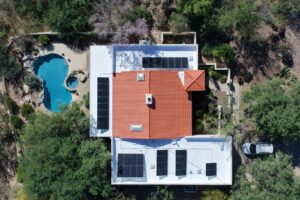
Why Las Vegas Solar Owners Need Professional Drone Inspections
Las Vegas gets more sunshine than nearly anywhere in North Americaâan average of 310 days per year with clear skies. That incredible solar resource makes solar energy a smart investment for homeowners and businesses across the Las Vegas valley. But here’s the catch: all that sun, combined with the Mojave Desert’s intense heat, dust storms, and occasional severe weather, creates a uniquely challenging environment for solar panels.
Your investment needs monitoring, maintenance, and when something goes wrong, fast diagnosis.
At Desert Drones, we specialize in FAA-certified drone solar inspections for Las Vegas residential and commercial properties. We’ve inspected panels on rooftops across the valleyâfrom suburban homes in Henderson and North Las Vegas to luxury estates in the foothills and massive commercial installations across the Las Vegas area.
We use thermal imaging and high-resolution photography to identify problems you can’t see from the ground, and we deliver actionable results fast. No climbing required. No unnecessary guesswork. Just data that helps you protect your solar investment.
How Las Vegas’s Climate Affects Solar Panel Performance
Las Vegas isn’t like other solar markets. The intense desert heatâregularly exceeding 100 degrees in summerâstresses solar equipment in ways that cooler climates don’t experience. Panels naturally get hotter in extreme heat, and that extra heat reduces efficiency.
Manufacturing defects that might go unnoticed in other climates become serious problems fast in Las Vegas. A panel with an internal flaw that loses 5% efficiency in California might lose 15-20% in Las Vegas’s sustained heat.
The dust and sand are another factor. Dust storms blow through regularly, coating panels with a fine layer of grime that reduces light penetration and output. Unlike rain in other regions, you can’t count on precipitation to clean your panels naturally. Many Las Vegas solar owners have experienced situations where their panels are generating 30-40% below expected output simply because they’re covered in dust.
Wind and occasional severe weather also take a toll. Dust storms create abrasive conditions. Hail, though less common than in other regions, does occur and can cause damage that thermal imaging reveals before panels fail completely. Temperature cyclingâthe extreme swings between day and night in the desertâstresses mounting hardware and electrical connections over time.
What Thermal Imaging Reveals About Your Las Vegas Solar Array
Our drones carry thermal imaging cameras that detect heat patterns invisible to standard photography. When a solar panel is underperforming or failing, it generates heat differently than a healthy panel. By scanning your array with thermal imaging, we create detailed heat maps showing exactly which panels aren’t performing properly and how severe the problem is.
Here’s why this matters: a panel that looks fine visually might be internally damaged. A tiny manufacturing crack or a failed diode inside the panel might not cause visible damage on the surface, but it absolutely kills performance.
A single failing panel in a string of panels can drag down the entire string’s output. Standard visual inspection would miss this completely. Thermal imaging reveals it immediately.
We can identify hot spots that indicate electrical faults or internal defects. We can spot panels that are significantly hotter or cooler than neighboring panelsâa sign of problems that need investigation. We can verify that all panels in an array are performing evenly, which indicates good system design and installation.
We can document the severity of any issues so you have clear evidence for warranty claims or insurance purposes.
Common Solar Problems We Find in Las Vegas Properties
In our experience inspecting Las Vegas solar systems, certain problems show up repeatedly. Soiling and dust accumulation is the most common issueâalso the easiest to fix. Dust storms coat panels, reducing output. Professional cleaning typically recovers efficiency loss immediately, but you can’t know how much efficiency you’re losing without baseline data from a clean inspection.
Manufacturing defects are surprisingly common. Some panel batches have higher failure rates than others. A homeowner might install a system with three or four defective panels mixed in with quality panels. The defects don’t cause immediate failureâthey cause slow degradation that owners might not notice for months or years. Thermal imaging catches these immediately, and proper documentation supports warranty claims.
Connection issues plague many Las Vegas installations. Poor connections between panels and the rest of the system, or within the inverter and wiring, cause heat buildup and efficiency loss. The desert’s temperature extremes exacerbate connection problems. Metal connections expand and contract constantly, sometimes loosening over time. Our thermal imaging reveals these problems clearly.
We also find equipment failures. Inverters fail. Combiner boxes develop problems. Wiring insulation deteriorates in the heat. These issues might not be visible from the ground, but thermal imaging and detailed inspection protocols reveal them. The sooner you know about equipment problems, the sooner you can get them fixed before they damage expensive components or create safety hazards.
Our Las Vegas Solar Inspection Process From Start to Finish
We keep our process straightforward and transparent. You contact us with information about your solar systemâinstalled capacity, approximate panel age, and any concerns you have. We discuss your specific situation and answer questions about what we’ll inspect and why. We schedule a drone inspection at a time that works for you, usually within a few days.
On inspection day, one of our FAA-certified pilots arrives with our drone and thermal imaging equipment. We review the site, conduct pre-flight safety checks, and brief anyone on-site about what we’re doing and how long the inspection will take.
We then fly a systematic pattern over your solar array at multiple altitudes, capturing both standard high-resolution photos and thermal imagery. Most inspections take 20-30 minutes of flight time.
Back at our office, we process and analyze all data carefully. We create thermal maps showing temperature variations across your array. We annotate photos highlighting any issues we’ve identified. We compile everything into a professional report that includes clear findings, recommendations, and next steps. The report typically reaches you within 5-7 business days.
What a Solar Inspection Report Actually Tells You
A good inspection report does more than show pictures. It explains what problems exist, why they matter, what’s causing them, and what you should do about it. Our reports include thermal mapping that shows temperature variations clearly. We annotate specific problem areas with explanations. We note whether issues are manufacturing defects (covered by warranty), operational concerns (cleanable or fixable), or safety hazards (need immediate attention).
We provide recommendations for next stepsâwhether that’s contacting the manufacturer for warranty service, scheduling professional panel cleaning, calling an electrician to inspect connections, or having your installer review system configuration.
The report is formatted to be useful both for property owners who want to understand their system and for solar installers or electricians who need technical detail. You can share it with your solar company if you want them to address issues.
You can use it for insurance claims or warranty disputes. You can keep it on file as documentation of your system’s condition on a specific date.
Real-World Las Vegas Solar Inspection Examples
We recently inspected a residential solar array in Henderson where the homeowner thought everything was working fine. Our inspection revealed one panel running consistently 15+ degrees hotter than its neighborsâa clear sign of internal failure. Thermal imaging made this obvious.
The homeowner contacted the installer, provided our inspection report as documentation, and the manufacturer replaced the panel at no cost. Simple issue, but without thermal imaging, it might have gone unnoticed for months.
For a commercial property in Las Vegas, we inspected a 150-panel system and found significant soiling reducing output by approximately 25%. The building management hadn’t realized their panels needed professional cleaning. After cleaning and our follow-up inspection, output recovered to near-optimal levels. The cost of the cleaning was recovered in just a few months of improved energy generation.
We also inspected a solar array that had been hit by a dust storm. Panels looked dusty but otherwise fine from the ground. Our thermal imaging revealed micro-fractures in several panels from the wind stress, damage that wasn’t visible but was degrading panel performance. Documentation from our inspection supported a warranty claim that got the panels replaced before serious failure occurred.
Protecting Your Las Vegas Solar Investment Starts With One Inspection
Solar panels are a significant investment. In Las Vegas’s heat and dust, they need monitoring to ensure they perform as designed. A professional drone inspection catches problems early when they’re easy and inexpensive to fix. It prevents small issues from becoming expensive failures.
It documents your system’s condition for warranty, insurance, and dispute-resolution purposes. And it gives you confidence that your investment is working as hard as the Las Vegas sun.
Ready to inspect your Las Vegas solar panels? Visit our Solar Inspection Services page to learn more or request a quote. Contact Desert Drones directly to schedule your inspection or discuss your specific concerns about your solar system.
We’re FAA-certified, experienced with Las Vegas’s unique climate and solar market, and committed to delivering honest, actionable inspection results. Let’s make sure your solar investment is protected and performing optimally.