
Mesa is booming with solar installations. Every week, new residential systems go up on homes in established neighborhoods across the city. HOAs are approving community solar projects. Commercial properties are switching to solar to reduce operating costs. The shift toward solar energy in Mesa is real, and it is accelerating fast.
If you have invested in a solar panel system, you have made a smart decision financially and environmentally. But here is what many Mesa homeowners do not realize: a solar system that is underperforming could be costing you money every single day. Regular drone solar panel inspections catch problems early, keep your system efficient, and maximize your return on that investment. For systems costing fifteen to twenty-five thousand dollars, regular maintenance is critical to protecting what you have put in.
We are Desert Drones LLC, and we use thermal imaging and high-resolution drone cameras to inspect solar arrays throughout Mesa, Gilbert, Chandler, and the surrounding east Valley. We identify underperforming panels, spot maintenance issues, and give you the information you need to keep your system operating at peak efficiency.
Why Solar Panel Systems in Mesa Need Regular Inspection
Your solar panels are exposed to Mesa’s intense desert sun more than 300 days a year. That is excellent for energy production, but it also means your panels are under constant stress. Panels can develop hot spots where cells are not functioning properly. Connections can loosen from the thermal expansion and contraction that comes with significant daily temperature swings. Dust, pollen, and debris from desert winds gradually reduce efficiency over time. Monsoon season brings wind and dust that can damage connections or deposit debris on panel surfaces.
If you are not regularly inspecting your system, you may have a problem you do not know about. A single failing panel in a 20-panel system can reduce the energy output for the entire array because the panels work as a connected system. You might be losing five, ten, or even more percent of your expected energy production without realizing it. That is money out of your pocket every month, month after month, quietly adding up.
How Thermal Imaging Works for Solar Inspection
Thermal imaging is the key to effective solar inspection. Every solar cell generates heat when it is working. A properly functioning cell produces consistent heat across the entire panel. A panel with internal problems — a broken cell, a faulty connection, a shorted section — runs hotter in that specific area than the surrounding panels.
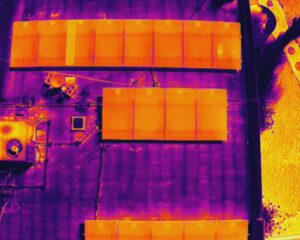
Our thermal imaging camera detects these temperature variations instantly and precisely. We fly the drone across your solar array and capture thermal images of every panel on your roof or ground-mounted system. Areas of abnormal heat show up clearly on the thermal images, identifying exactly which panels have problems and where.
We pair thermal imaging with visible-light photography to document physical issues — debris accumulation, physical damage, loose or exposed wiring, anything visible to the camera. Combined, these two data sources give us a complete picture of your system’s condition and performance.
The Mesa and East Valley Solar Installation Boom
Mesa has embraced solar energy enthusiastically. Between residential homeowners installing rooftop systems and commercial properties going solar, the number of installations across the east Valley has grown dramatically. Near Arizona State University’s Polytechnic Campus, out toward the Usery Mountain area, and throughout established Mesa neighborhoods, solar has become a common sight.
For HOA-managed communities with shared solar installations, regular inspections are even more critical. A large system serving multiple properties or buildings absolutely requires professional maintenance to ensure it is performing as designed. A five percent underperformance on a commercial-scale system represents significant lost revenue annually, and identifying that through a professional inspection is a straightforward return on investment.
Our Complete Solar Inspection Process
Here is what we do: You contact us with details about your system — its size, location, and installation date. We schedule an inspection at an optimal time, typically morning or afternoon when the sun angle provides the best thermal readings. Mesa’s clear skies are ideal for thermal imaging, with minimal atmospheric interference.
We arrive with our thermal imaging drone and conduct a thorough inspection of your entire array. We capture thermal images of every panel, visible-light photos of the whole system, and close-up images of any areas that show abnormal readings or physical concerns. We document everything systematically and professionally.
Within a few days, you receive a detailed report with thermal images, visible photos, and our specific recommendations. We tell you which panels are underperforming, what the likely issue is, and what steps we recommend. We explain everything in plain language — no technical jargon. We can also recommend local contractors if repairs are needed and provide documentation for warranty claims if applicable.
Identifying Hot Spots and Failing Solar Cells
Hot spots are one of the most common problems in residential and commercial solar systems. A single failing cell in a panel, a broken internal connection, or a manufacturing defect causes that area to run significantly hotter than the surrounding panel. Over time, that hot spot damages adjacent cells and reduces the entire panel’s output — sometimes dramatically.
Thermal imaging reveals hot spots immediately. We can tell you exactly which panels have them, how severe the temperature differential is, and help you prioritize repairs. Sometimes a panel with a hot spot just needs service — a connection tightened or sealant refreshed. Sometimes the panel needs replacement. Either way, you know what you are dealing with and can act on accurate information rather than guesses.
Preventive Maintenance That Pays for Itself
Think about your solar investment for a moment. How much did you spend on the system? For most Mesa residential installations, it is somewhere between ten and twenty-five thousand dollars. That is a significant investment worth protecting. Regular drone inspections — costing perhaps 150 to 300 dollars annually — help you protect that investment systematically.
If an inspection identifies an issue that is costing you even 50 dollars per month in lost energy production, the inspection pays for itself in three months. For commercial systems in the Gilbert and Chandler area, the math is even more compelling. A five percent efficiency loss on a 50-panel commercial system might represent several thousand dollars annually in lost energy revenue. A professional inspection that costs a few hundred dollars identifies that problem immediately.
Inspection Services for Residential, HOA, and Commercial Systems
We inspect residential rooftop systems, ground-mounted residential arrays, and commercial installations throughout Mesa and the east Valley. Whether you have a small rooftop array or a larger ground-mounted system near Tonto National Forest, we have the capability and expertise to inspect it thoroughly.
We work with commercial property managers, HOA boards, and facility operators throughout Mesa. We understand what these larger systems need and provide the detailed documentation required for operational oversight, maintenance planning, and governance reporting. We have worked with HOAs managing shared solar for 50 to 100 homes and commercial operators who need regular performance data for financial and regulatory reporting.
Arizona’s Solar Growth and Your Investment
Arizona leads the nation in solar adoption, and Mesa is at the forefront of that trend. More homes and businesses go solar every year. If you are part of that movement, regular drone inspection keeps your system performing at its best. It is not a luxury — it is responsible ownership of a significant energy asset.
Many Mesa homeowners installed systems three to five years ago and have not had them professionally inspected since installation. If that describes you, it is time for a professional evaluation. You might be surprised at what we find — and at how much money you have been leaving on the table.
Ready to schedule? Contact Desert Drones LLC today to set up your drone solar panel inspection in Mesa. Whether you are near the Mesa Arts Center, in the Usery Mountain area, managing commercial properties in Gilbert or Chandler, or anywhere in the east Valley, we will make sure your solar system is performing exactly as it should. Reach out now for your quote.