
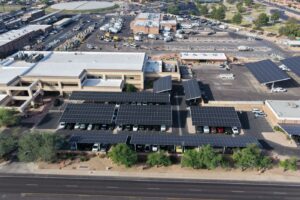
Texas has become one of the biggest solar markets in the country, and the Dallas-Fort Worth metro is right at the center of it.
Hail is the issue nobody wants to talk about. DFW sits in the heart of Hail Alley, and the same storms that batter rooftops across Frisco, Plano, McKinney, and Irving every spring and summer are landing directly on solar panels. A hailstorm that looks survivable from the ground can leave micro-cracks in solar cells that reduce output by 15 to 20 percent without a single visible panel shattering. You won’t see it. Your inverter data might hint at it. But you won’t know for sure until you get eyes on every panel from directly above.
That’s what Desert Drones LLC does across the Dallas metro. We fly FAA-certified drone solar inspections for residential homeowners, commercial property managers, solar installers, and O&M contractors who need fast, accurate aerial documentation of panel condition — after hail, after high winds, after installation, or as part of regular maintenance cycles.
Why Dallas Solar Systems Need Drone Inspection
Dallas-area solar installations face a specific set of challenges that most solar markets don’t deal with at the same intensity. Hail is the biggest. But the DFW climate also delivers extreme heat cycling that stresses panel frames and junction boxes, high winds that can shift racking and create micro-cracks at panel edges, and heavy spring storms that deposit debris across rooftop arrays in ways that affect both output and panel longevity.
A standard ground-level walk around the base of a building tells you almost nothing about panel condition. Even getting eyes at roofline level from a ladder gives you an angle that misses most of what matters — the top surface of the panels where hail impact, soiling, and delamination show up. The only way to see what’s actually happening across a rooftop solar array is from directly above, close enough to see individual cells.
From 20 to 40 feet above the array with a high-resolution camera, we can see hail impact marks, cell discoloration from hot spots, soiling patterns, wiring and junction box condition, racking alignment, and any structural issues with the mounting system. For large commercial arrays, we can cover tens of thousands of square feet of panels in a single flight.
Residential Solar Inspections in Dallas
Dallas-area residential solar adoption has accelerated significantly, and the communities taking the most advantage of solar energy tend to be in areas that also get hit hardest by hail — Frisco, Allen, McKinney, Prosper, Southlake, and Flower Mound all rank among the higher-solar-adoption suburbs in the metro, and all of them see regular hail events.
For homeowners, a post-storm drone inspection serves two immediate purposes. First, it gives you documentation of panel condition immediately after a storm event — which is exactly what your insurance company needs to process a claim. Second, it tells you whether your system is actually performing the way it should, or whether invisible damage is quietly costing you in reduced output month after month.
We deliver residential solar inspections with a full 4K video pass over the array, close-up high-resolution stills of each panel section, and a written report documenting visible damage, soiling, and any areas of concern. Turnaround is 24 hours. If you need the report for an insurance claim, we format it so your adjuster can use it directly.
Commercial Solar Inspections Across DFW
The DFW commercial solar market has expanded dramatically across industrial and logistics properties, retail centers, schools and municipal buildings, and large corporate campuses. The Great Southwest Industrial District in Irving and Grand Prairie, the warehouses along I-20 in South Dallas, the distribution centers lining I-35E through Lewisville and Carrollton — a significant number of these properties are now running large rooftop solar arrays that need regular inspection to maintain performance and warranty compliance.
For commercial O&M contractors, our drone inspection service fits directly into scheduled maintenance workflows. We can run inspection flights across multiple properties in a single day, delivering consistent documentation for your service records and client reporting. Volume pricing available for contractors managing multiple commercial accounts.
For commercial property owners and asset managers, drone solar inspection provides the independent third-party documentation you need for warranty claims, insurance submissions, and performance verification. If your array is underperforming relative to projections, aerial inspection is often the fastest way to identify whether the issue is panel-level damage or a systemic shading or soiling problem.
Post-Hail Storm Inspections
The most time-sensitive solar inspection work in Dallas happens right after significant hail events. Insurance policies have reporting windows, and solar manufacturers’ warranties have damage documentation requirements that often specify inspection within a certain timeframe after a storm.
After a hail event in the DFW area, we prioritize storm inspection requests and move as quickly as possible to get flights scheduled. We track NOAA hail reports and can proactively reach out to clients in affected zip codes when significant events occur.
A post-hail drone inspection delivers timestamped, GPS-tagged imagery of every panel immediately after the storm — exactly the documentation package your insurance adjuster or solar manufacturer needs. We’ve seen claims go sideways because homeowners and property managers waited weeks to document damage. Getting us out within a few days of the storm makes the claims process significantly smoother.
Thermal Imaging for Performance Issues
Standard camera inspection identifies visible surface damage — hail impacts, soiling, delamination, and racking issues. For performance problems that don’t show up visually, we offer FLIR thermal imaging as an add-on.
Hot spots in solar panels show up clearly on thermal imagery as temperature differentials across the panel surface. A cell that’s failing due to micro-cracking, bypass diode issues, or a shading-induced mismatch runs hotter than surrounding cells — and that heat signature is invisible to a standard camera but obvious on thermal. For large commercial arrays where output data shows underperformance but visual inspection hasn’t identified the cause, thermal imaging is the fastest way to find the problem panels.
Airspace and FAA Compliance in Dallas
Commercial drone operations in Dallas require navigating the airspace around Dallas Love Field, Dallas Executive Airport, and the broader DFW Terminal Control Area covering the entire metro. DFW International Airport’s Class B airspace is one of the largest in the country and requires careful LAANC coordination for flights in a significant portion of the metro.
All of our Dallas flights are conducted under FAA Part 107 certification with LAANC authorization where required. We handle airspace coordination before every flight and keep authorization records on file. If your property is in a restricted airspace zone, we factor that into scheduling upfront so there are no day-of surprises.
Schedule a Dallas Solar Inspection
Whether you just took a hailstorm, you’re coming up on a warranty inspection milestone, or you’re seeing output numbers that don’t match your projections, a drone solar inspection gives you the ground truth on what’s actually happening with your panels.
Book a Dallas Solar Panel Inspection
Residential and commercial inspections available across the full DFW metro. Reports delivered within 24 hours. Call or book online and we’ll get a flight on the schedule fast.
Frequently Asked Questions
How do I know if my solar panels have hail damage?
Most hail damage on solar panels is invisible from the ground. Micro-cracks in the glass and cell damage from impact reduce output without shattering panels visibly. If your system’s production numbers have dropped after a storm, or if hail was reported in your area, a drone inspection is the fastest way to document what actually happened.
What does a Dallas drone solar inspection include?
Every inspection includes a full 4K video pass over the array, close-up high-resolution stills of each panel section, and a written damage report with annotated imagery. The report is formatted for insurance adjuster review and solar manufacturer warranty submissions. Turnaround is 24 hours.
Do you offer thermal imaging for solar panels in Dallas?
Yes. FLIR thermal imaging is available as an add-on. Thermal cameras detect hot spots caused by cell failures, micro-cracks, and bypass diode issues that do not show up visually but cause real output loss. For commercial arrays showing underperformance, thermal is the fastest way to find the problem panels.
How soon after a Dallas hailstorm should I schedule a solar inspection?
As soon as possible. Insurance policies have reporting windows, and solar warranties often require timely damage documentation. We prioritize post-storm inspection requests in the DFW area and can often schedule within 24 to 48 hours of a significant hail event.