
Monsoon season is Tucson’s #1 roof killer — and most homeowners don’t find out until water is already inside.
Every summer, the same story plays out across the Foothills, Marana, Sahuarita, and the Eastside: a storm rolls through, winds hit 60 mph, hail the size of marbles hammers tile and foam, and by morning everything looks fine from the street. The damage is up on the roof — and it stays hidden until a leak appears, sometimes months later.
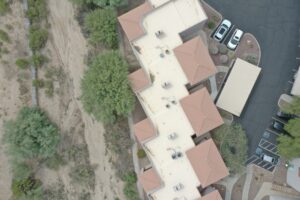
That gap between damage and discovery is exactly what Desert Drones LLC was built to close. We fly FAA-certified drone roof inspections across the Tucson metro, capturing high-resolution aerial imagery and 4K video before and after storm season so you know exactly what’s up there — without ladders, without delay, and without guesswork.
Why Tucson Roofs Are Different
Tucson isn’t a one-size-fits-all roofing market. Drive through any neighborhood from the Catalina Foothills down to Rita Ranch and you’ll see a mix that would confuse a roofer from the Midwest: flat foam roofs on mid-century ranch homes, Spanish tile on newer builds, TPO membrane on commercial flat-tops along Oracle Road, and the occasional metal roof catching the sun out near Saguaro National Park West.
Each surface type has its own monsoon vulnerability. Foam roofs are susceptible to ponding water when drains clog with debris. Spanish tile can crack from hail impacts that leave no mark visible from the ground. TPO seams lift when wind creates uplift pressure along parapet walls. And any flat roof with a drain in the wrong spot becomes a pond after a heavy July storm.
A traditional ladder-and-walk inspection covers maybe 30% of a typical roof because inspectors can’t safely walk wet tile, steep pitches, or commercial flat roofs without serious risk. Drone inspection covers 100% — every ridge line, every drain, every seam — from angles and altitudes a person on a ladder can never reach.
How Our Drone Roof Inspections Work
The process is straightforward. You schedule online or call us, and we come out — usually within 24–48 hours in the Tucson area. We fly our commercial-grade drone over the full roof structure, recording 4K video and shooting high-resolution stills at multiple angles: top-down, 45-degree oblique, close-up on problem areas.
We operate under FAA Part 107 certification, which means every flight is legal, insured, and logged. In certain Tucson airspace — particularly near Tucson International Airport on the south side and Davis-Monthan Air Force Base on the east — we file LAANC authorization before we fly. You don’t have to worry about any of that. We handle it.
After the flight, we put together a damage report: annotated images marking every crack, lifted seam, puncture, ponding area, or damaged flashing we spot. The report is delivered digitally — usually same day or next morning — and formatted so you can hand it directly to your roofer for a repair estimate or to your insurance adjuster for a claim.
Pre-Monsoon Inspections: Get Ahead of the Storm
The best time to do a roof inspection in Tucson is before the monsoon hits — typically May or early June, before the first pulse of moisture rolls up from the Gulf of California.
A pre-monsoon drone inspection tells you what you’re starting with. If there’s existing damage from last year’s storm season or from winter freeze-thaw cycles up in the Foothills, you want to know now — not in August when roofers are booked solid and roofing cement prices spike.
We document your roof’s baseline condition with time-stamped, GPS-tagged imagery. If a storm causes new damage later in the season, you have clear before-and-after evidence for your insurance company. That documentation can be the difference between a claim being approved or disputed.
Post-Monsoon Inspections: Document What the Storm Left Behind
After a significant storm event — especially anything with winds over 40 mph or hail reports in your zip code — a post-monsoon inspection is worth doing fast. Insurance policies typically require damage to be reported within a certain window, and having a drone inspection report filed quickly puts you in a much stronger position.
We’ve flown post-storm inspections across Tucson neighborhoods including:
- Sam Hughes and Rincon Heights — older homes with Spanish tile that chips and slides in high wind
- Marana and Dove Mountain — newer construction with flat foam elements that take hail hard
- The Foothills along Skyline Drive — steep-pitch roofs with complex ridgelines that are nearly impossible to inspect on foot
- South Tucson and Drexel Heights — commercial and industrial properties with large TPO and gravel-built-up roofs
If you’re a roofing contractor, we can schedule back-to-back inspections across multiple properties after a storm event — we regularly do 4–6 roof inspections in a single day across the metro.
What We Look For
Our pilots are trained to identify and document specific types of monsoon and weather damage:
Hail damage shows up as circular impact marks on tile or shingles, soft spots on foam, and dents or dings in metal flashing or vents. From the ground, these are nearly invisible. From 30 feet up with a 48-megapixel sensor, they’re obvious.
Wind damage includes lifted or missing tiles, separated flashing at chimneys and skylights, torn TPO membrane at seams, and debris impact damage. High-wind events along the Santa Cruz River corridor can pull roofing materials off in sections.
Ponding and drainage issues — after heavy rain, flat roofs often reveal drainage problems that weren’t obvious before. Ponding water left standing for more than 48 hours accelerates membrane degradation significantly.
Cracked or displaced foam is especially common in Tucson’s heat cycles. UV exposure causes foam to harden and crack over time, and a monsoon storm can open those cracks into real leaks.
Flashing failures at skylights, HVAC penetrations, and parapet walls are among the most common leak sources on Tucson commercial properties — and they’re easy to spot from the air.
Who Uses Drone Roof Inspections in Tucson?
Homeowners going into or coming out of monsoon season who want peace of mind without climbing on the roof themselves.
Real estate agents and buyers — roof condition is one of the most common deal-killers in Tucson real estate. A drone inspection during escrow gives buyers a clear picture before closing and gives sellers documentation to negotiate from.
Roofing contractors who want to generate detailed estimates without putting crews on roofs unnecessarily, or who need documentation for insurance supplements.
Property managers overseeing multi-family housing, commercial strips, or HOA-managed properties across the metro who need scalable, affordable inspection options.
Insurance adjusters and public adjusters who need independent aerial documentation to support or validate claims.
Coverage Area
Desert Drones LLC operates across the full Tucson metro and surrounding communities. Our standard coverage area includes Tucson proper, Marana, Oro Valley, Sahuarita, Green Valley, Vail, Rita Ranch, and the Catalina Foothills. We also fly extended projects in Sierra Vista, Benson, and Nogales — call for scheduling and pricing on those.
For commercial properties larger than 50,000 square feet or roofing contractor accounts needing regular volume inspections, ask about our contractor partnership program.
What’s Included in a Desert Drones Roof Inspection
Every inspection includes: full-property drone flight, 4K video recording, high-resolution still photography, annotated damage report with GPS-tagged images, digital delivery within 24 hours, and a follow-up call to walk through findings.
Optional add-ons include FLIR thermal imaging (identifies moisture intrusion below the surface that standard cameras can’t see), interior leak-point mapping for active leaks, and expedited same-day turnaround for urgent insurance claims.
Ready to Schedule?
Stop guessing what’s on your roof. A drone inspection takes less than an hour on-site and gives you a complete, documented picture of your roof’s condition — before the next storm hits or after the last one.
Whether you’re a homeowner in the Foothills, a property manager in Midtown, or a roofing contractor working across the metro, Desert Drones LLC has you covered. Call or book online — we’ll be out fast, and you’ll have your report in hand before your roofer even answers the phone.
Frequently Asked Questions
How much does a drone roof inspection cost in Tucson?
Pricing varies based on roof size and complexity. Residential inspections in Tucson typically range from $150 to $300. Commercial properties and large flat roofs are priced based on square footage. Contact us for a quick quote — most properties can be quoted in minutes.
How soon after a monsoon storm should I get a drone roof inspection?
As soon as possible — ideally within a few days of the storm. Insurance policies have reporting windows, and solar manufacturers have warranty documentation requirements that specify timely inspection after damage events. The sooner you have documented proof, the stronger your claim.
Can a drone roof inspection be used for insurance claims in Arizona?
Yes. Our inspection reports include time-stamped, GPS-tagged imagery and a written damage summary formatted specifically for insurance adjusters. We have helped Tucson homeowners and property managers successfully document claims after monsoon hail and wind events.
Do you fly near Davis-Monthan or Tucson International Airport?
Yes. We file LAANC authorization before every flight in controlled airspace near Davis-Monthan AFB and Tucson International Airport. All flights are fully compliant with FAA Part 107 regulations. You do not need to handle any of the airspace coordination.
Frequently Asked Questions
How much does a drone roof inspection cost in Tucson?
Residential inspections in Tucson typically run $150 to $300 depending on roof size and complexity. Commercial properties and large flat roofs are quoted by square footage. Contact us for a fast quote — most properties can be estimated same day.
How soon after a monsoon storm should I get a drone inspection?
As soon as possible — ideally within a few days of the event. Insurance policies have reporting windows, and having documented proof quickly puts you in a much stronger position when filing a claim. We prioritize post-storm requests.
Can a drone inspection be used for an insurance claim in Arizona?
Yes. Our reports include time-stamped, GPS-tagged imagery and a written damage summary formatted for insurance adjusters. We have helped Tucson homeowners and contractors successfully document monsoon hail and wind claims.
Do you fly near Davis-Monthan AFB and Tucson International Airport?
Yes. We file LAANC authorization before every flight near Davis-Monthan and TIA. All flights are FAA Part 107 compliant. You do not need to handle any airspace coordination — we take care of everything before we arrive on site.