
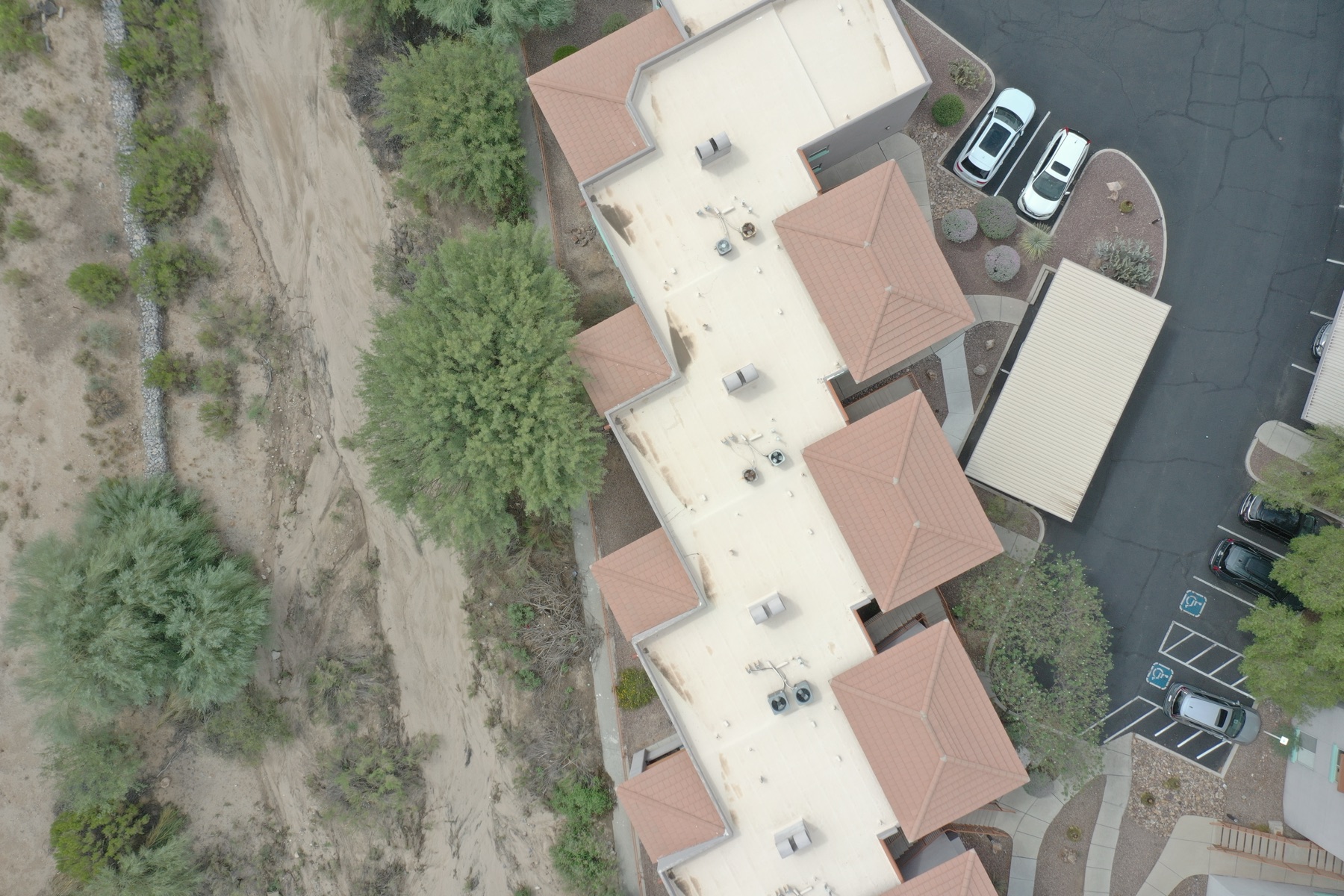
El Paso doesn’t get a lot of rain, but when it does, it can be violent. Monsoon season rolls in from July through September with sudden storms that bring hail, heavy downpours, and high winds — sometimes all at once. A roof that looked fine in June can come out of a July storm with cracked tiles, dented metal, lifted shingles, and damage that won’t reveal itself until months later when water finally finds its way inside.
The other issue is the sun. El Paso averages around 297 sunny days a year. That’s year-round UV bombardment and heat cycling — hot days, cooler nights, repeat — that degrades roofing materials faster than most people realize. By the time a shingle looks obviously bad from the ground, it’s been failing for a while.
Drone roof inspection el paso properties need is the smart way to stay ahead of both problems. Instead of waiting for a water stain to appear on your ceiling, you can get eyes on your roof every year and know exactly what’s happening up there. We’ve inspected hundreds of El Paso roofs and we know what storm damage, heat damage, and normal wear look like in this specific climate.
Why El Paso Roofs Need More Attention Than You’d Think
Most people hear “El Paso” and think dry desert — not exactly a city where roofs take a beating. But there are two major forces working against roofs here year-round.
First is the UV exposure. The Chihuahuan Desert sits at 3,700 feet elevation, which means thinner atmosphere and more intense solar radiation. Asphalt shingles lose granules, dry out, and crack faster here than in lower-elevation climates. Tile roofs hold up better but grout and flashing still degrade. Flat roofs on commercial buildings get absolutely hammered by UV — membranes become brittle, seams open up, and ponding water becomes a real problem over time.
Second is the monsoon season. People underestimate how intense El Paso storms can get. When a monsoon cell rolls in, it’s not a gentle rain — it’s often a short, violent event with strong winds and hail mixed in. One storm can cause enough hail damage to justify an insurance claim, and if you’re not documenting conditions right after the storm, you’re behind the eight ball when it comes time to file.
Hail Damage and Insurance Claims: Why Documentation Matters
When hail hits, roofing contractors and insurance adjusters need documentation fast. Hail damage isn’t always visible from the ground — you need close aerial shots showing impact patterns, dents, bruising on shingles, cracked tiles, and granule displacement. That documentation is what substantiates a claim and gets homeowners the coverage they’ve been paying for.
Drone roof inspection el paso contractors rely on after storms has become standard practice for the same reason. When you’re coordinating with insurance adjusters and homeowners on repair scope, photos from the ground aren’t enough. Aerial imagery with GPS-tagged photos shows exactly where damage is, how extensive it is, and what needs immediate attention versus what can wait. It’s cleaner documentation, faster turnaround, and fewer arguments about scope.
We’ve worked with El Paso roofing contractors who use our drone inspection footage as part of their standard estimating and documentation workflow. It makes the entire process smoother — for them, for homeowners, and for adjusters who need to close claims efficiently.
What We Inspect and Document
A standard drone roof inspection covers the full roof surface from multiple angles: ridge lines, valleys, field areas, eaves, flashing around chimneys and vents, and any roof penetrations. We capture high-resolution stills and 4K video of all areas, with particular attention to problem zones — low-slope areas where water can pond, valleys where debris accumulates, and flashing points where seals tend to fail first.
For post-storm documentation, we do a systematic grid flight capturing overlapping photos of the entire roof surface. This creates a complete visual record you can share directly with insurance adjusters or contractors. For routine maintenance inspections, we add thermal imaging that reveals moisture trapped in insulation or under membranes — water that’s already getting in but hasn’t shown up as a stain yet.
We also document HVAC equipment on flat roofs, satellite dishes, vents, and anything else on the roof surface that might be damaged or compromised. Full report with annotated photos, condition ratings, and recommended action comes back to you within two to three business days.
Residential Inspections: Single-Family Homes and HOAs
El Paso has a ton of HOA communities — especially in the Northeast side, Upper Valley, and East El Paso areas. Community-wide roof inspections after major storms are a big part of what we do here. Instead of sending people up ladders to inspect dozens or hundreds of homes, we fly the community in one or two sessions and deliver a complete condition report for every roof.
For individual homeowners, drone inspection makes sense before any major roofing decision. If you’re being told you need a full replacement, it’s worth having independent documentation of what’s actually on your roof. If you’re buying or selling a home and the roof’s age or condition is in question, inspection photos give everyone accurate information to work from. If you’ve had a recent storm and want to know if you have a claim worth filing, pre-inspection documentation before you call a contractor puts you in a much stronger position.
Commercial and Flat Roof Inspections
El Paso’s commercial real estate — warehouses near the Ysleta port of entry, industrial properties along I-10, office buildings in downtown and Eastside, retail along Montana Avenue and Airway Boulevard — tends toward flat and low-slope roofing systems. These are efficient for large footprints but require more consistent maintenance than pitched roofs.
Flat roof failures happen gradually. A small seam opening lets in a little water. That water saturates insulation over time. The saturated insulation creates thermal bridging and eventually enough moisture damage that a simple repair becomes a full replacement. Drone inspection with thermal imaging catches this early, when a targeted repair is still a viable option. We’ve caught moisture intrusion on El Paso commercial roofs that owners had no idea was happening — addressed early, it’s a repair rather than a replacement.
How Drone Inspection Compares to Traditional Methods
Traditional roof inspection means climbing ladders, walking on roof surfaces, and manually checking problem areas. In El Paso’s heat — roof surfaces regularly hit 160°F in summer — that’s miserable and potentially dangerous work. Drone inspection removes that entirely: no one’s climbing anything, no one’s walking on fragile tile, no one’s dealing with rooftop heat.
The other advantage is consistency and coverage. A person walking a roof can only look at what they can physically get to and see. A drone captures the entire surface from multiple angles, including areas that are difficult to reach safely on foot. The result is more complete documentation with better photographic evidence than any ground-level or ladder inspection can provide.
Speed matters too. We can inspect a residential roof in 20 to 30 minutes of flight time. A commercial property takes 45 minutes to an hour. Compared to manual inspection scheduling, access coordination, and time on the roof, drone inspection is dramatically faster — which matters when you’re trying to move quickly after a storm.
Working with Roofing Contractors and Adjusters
We work with El Paso roofing contractors and insurance adjusters regularly, and we’ve gotten good at producing documentation that’s actually useful in the field. Our reports are formatted for direct use in insurance submissions — GPS-tagged photos, condition ratings, annotations showing specific damage areas, and a written summary that an adjuster can reference quickly.
For contractors, we can turn around inspection reports fast enough to include in same-day estimates. Some contractors have us inspect before they even put an estimator on the property, so by the time they’re discussing scope with the homeowner they already have aerial documentation to reference. It makes the estimating and proposal process significantly cleaner.
Schedule Your El Paso Roof Inspection
Whether you’ve just had a hail storm and need documentation for a claim, you’re managing an HOA and want community-wide condition data, or you just haven’t had your roof inspected in a few years and want to know what’s going on up there — drone inspection is the right tool for El Paso’s climate and the types of damage this desert environment creates.
FAA-certified, insured, experienced with El Paso roofs and what the Chihuahuan Desert does to them over time. We know what to look for and how to document it in a way that’s actually useful.
Contact Desert Drones LLC to book your El Paso drone roof inspection. Visit desertdronesllc.com or call for a free quote on residential, HOA, or commercial roof inspections in El Paso, TX.